

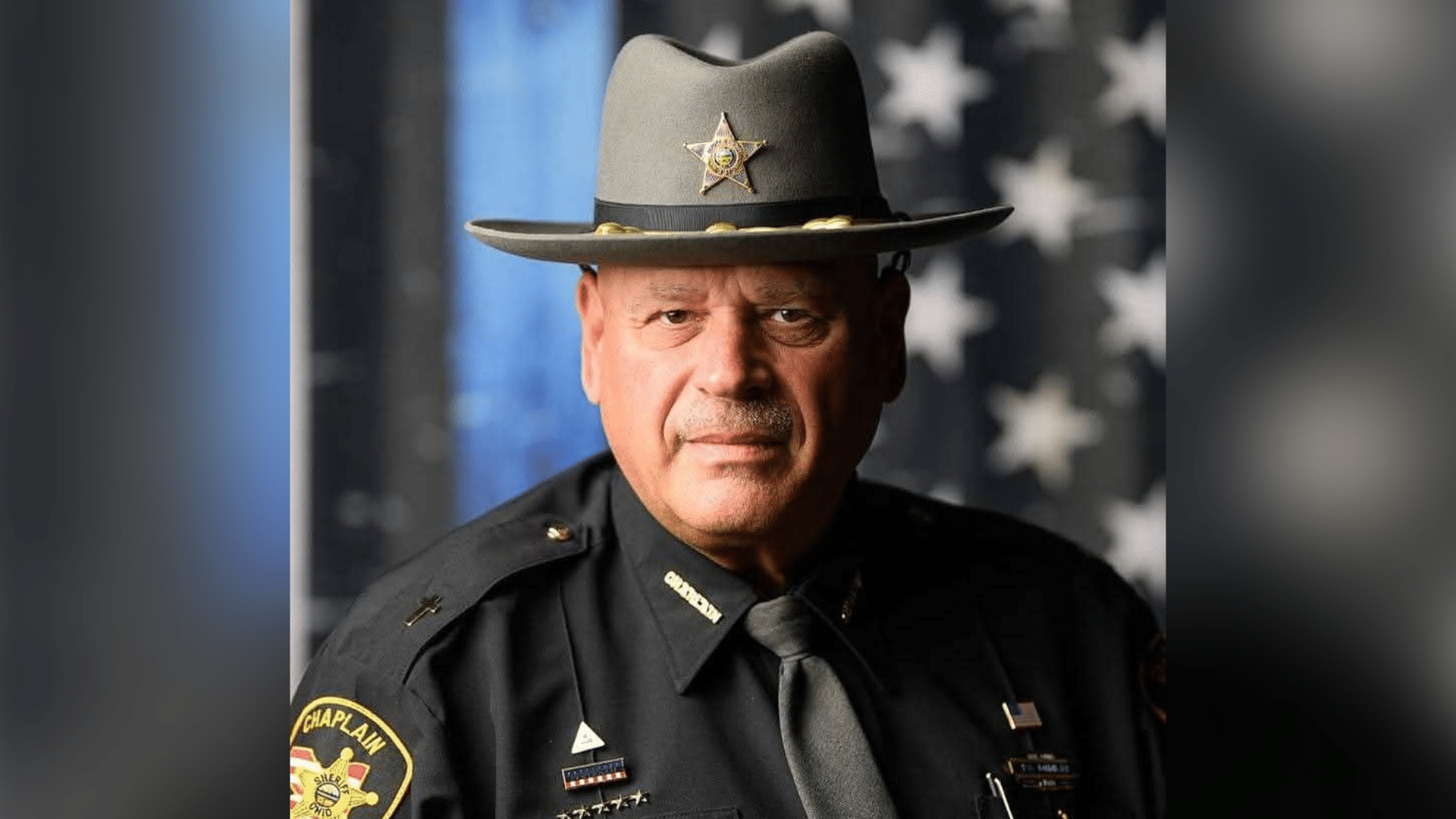








When a Stark County sheriff’s deputy is struggling with something they witnessed on the job, dealing with a personal crisis or simply needs someone to listen, Senior Chaplain Philip W. Lohmeyer wants them to know they do not have to face those challenges alone.
Sometimes, that means riding alongside a deputy during a shift. Other times, it involves visiting a hospital, comforting a grieving family or finding a quiet corner of the sheriff’s office to pray with an employee.
For Lohmeyer, whose career spans more than four decades in military service, law enforcement and emergency services, being a chaplain is about much more than religion.
It is about being present for the people who spend their lives protecting others.
“I think we always talk about chaplaincy as being just a ministry of presence,” Lohmeyer said during a recent interview with Jordan Miller News.
But that presence, he explained, must be built on relationships, trust and a genuine understanding of the challenges first responders encounter.
Lohmeyer knows those challenges firsthand. He has spent much of his adult life wearing a uniform himself.
A lifetime of public service
A 1984 graduate of Canton McKinley High School and its vocational law enforcement program, Lohmeyer began his public service career as a member of the Canton Police Youth Corps.
He later served as a deputy sheriff in Tuscarawas County, police chief in Bolivar and jail administrator in Ottawa County.
His career also included serving as village administrator in Centerburg from 2007 to 2018 and as fire marshal for the Central Ohio Joint Fire District before retiring from that position in 2022.
Along the way, Lohmeyer served as an emergency medical services first responder and firefighter.
His military career has been equally extensive.
Lohmeyer spent 14 years in the U.S. Army Reserve and six years in the Ohio Army National Guard, serving as a military police sergeant and safety noncommissioned officer.
He continues to serve with the Ohio Military Reserve, where he holds the position of acting command sergeant major for the 1st Battalion in Highland Hills.
He also works as an instructor for the Federal Emergency Management Agency and Ohio Emergency Management Agency, teaching courses involving emergency operations, planning, logistics and incident command.
Despite those accomplishments, Lohmeyer said his calling eventually led him in a different direction.
Finding his calling
Lohmeyer grew up influenced by his grandfather, Ancil Fisher, a World War II veteran and Pentecostal preacher from West Virginia.
Family members often told him he would someday follow in his grandfather’s footsteps.
For years, he resisted the idea.
“I always kind of fought that, but always kind of felt a calling to ministry,” Lohmeyer said. “I always wanted to be in law enforcement.”
In 2012, while working full time, he began pursuing ministry through a training program offered by the Christian and Missionary Alliance.
After completing the requirements for licensure in 2015, Lohmeyer began serving as a district disaster response coordinator for the Christian and Missionary Alliance and as a U.S. disaster response coordinator for CAMA Services.
He later completed additional supervised ministry training toward ordination.
But Lohmeyer never felt called to lead a traditional church congregation.
Instead, he wanted to minister to the people he understood best: first responders.
“I would much rather sit down with guys or girls on the back of a fire truck or in a cruiser or in a corner of a hallway somewhere and, hey, how are you doing? What are you going through?” he said.
His chaplaincy work began with the Knox County Sheriff’s Office, where he volunteered while living in central Ohio.
Several years later, family circumstances brought him back to Canton.
Lohmeyer and his wife, DeeAnne, returned to the area to help care for his mother, who was showing signs of dementia.
He subsequently joined the Stark County Sheriff’s Office under former Sheriff George Maier and continued serving following the arrival of Sheriff Eric Weisburn.
Today, he works full time as the department’s senior chaplain.
Building trust behind the badge
Lohmeyer said one of the most important parts of his job is earning the confidence of deputies and other sheriff’s office employees.
He understands that law enforcement officers are not always quick to open up, particularly when discussing personal struggles or traumatic experiences.
His own background in law enforcement helped establish credibility, but trust still had to be earned.
“I came with a little bit of street cred,” Lohmeyer said.
Initially, some employees wondered whether conversations with the chaplain would eventually be shared with department leadership.
Lohmeyer said he and Weisburn established an understanding about maintaining employees’ trust.
“He would never ask, and I would never tell,” Lohmeyer said.
The sheriff may ask him to check on an employee who appears to be struggling, but Lohmeyer said their private conversations are not routinely shared with supervisors.
That relationship has allowed him to become someone employees can approach about difficult calls, family problems, marriage struggles and other personal matters.
Sometimes, a deputy will simply ask him to ride along during a shift.
Those hours inside a cruiser often provide opportunities for conversations that might never happen in an office.
Lohmeyer said first responders routinely encounter disturbing situations that can be difficult to explain to their families.
“You see things, hear things and smell things, and I pray nobody else ever has to,” he said.
For years, he said, law enforcement culture often encouraged officers to suppress those experiences rather than discuss them.
He believes that attitude has gradually changed, but challenges remain.
Lohmeyer also serves on Assist 76, Stark County’s critical incident peer support team, which helps emergency personnel process traumatic events, including serious crashes, major fires and other critical incidents.
His goal is to ensure employees understand that asking for help is not a weakness.
In his introductory letter to the department, Lohmeyer wrote that trauma can affect anyone and that seeking assistance is the first step toward a healthier life.
Supporting families beyond the job
The chaplain’s work frequently extends beyond sheriff’s office employees to their spouses and children.
Lohmeyer said the unpredictable schedules and emotional demands of law enforcement can create challenges at home, particularly for younger deputies and their families.
A deputy might be scheduled for a shift but end up working 12 or 16 hours because of an emergency.
Meanwhile, a spouse may struggle to understand why their loved one comes home exhausted, withdrawn or reluctant to discuss the day.
Lohmeyer’s wife helps support the department’s spouses group, offering perspective on the realities of being married to a first responder.
The couple hopes to develop a more formal program to help families navigate those challenges.
Lohmeyer recalled one deputy who became seriously ill and required treatment at a Cleveland hospital.
The deputy’s wife was uncomfortable driving back and forth to Cleveland, so Lohmeyer offered to take her when other family members or friends were unavailable.
He made multiple trips, spending time with the family and visiting the deputy during his hospitalization and rehabilitation.
“That meant the world to them, you know, just to be able to do that,” Lohmeyer said. “I just felt like, well, heck, that’s something I can do. Why wouldn’t I do that?”
At one point, Lohmeyer doubted the deputy would ever return to work.
But the employee eventually recovered enough to return to duty.
“He’s back in uniform and back working and doing a great job,” Lohmeyer said.
Those experiences, he explained, illustrate how chaplaincy can involve simple acts of kindness rather than formal religious services.
He also officiates weddings and funerals for employees and their families, often stepping in when someone does not have a home church.
A chaplain for everyone
Although Lohmeyer is a Christian minister, he emphasizes that his responsibility is to serve all employees, regardless of their religious beliefs.
Some employees practice different faiths, while others do not identify with any religion.
Lohmeyer said respecting those differences is essential.
“We are a chaplain for all here,” he said.
His introductory letter emphasizes that he operates through informed consent and does not push his religious beliefs on others.
He believes meaningful spiritual conversations can only happen after relationships and mutual respect have been established.
“You need to build a relationship with somebody first before you can speak truth into their life,” he said.
The sheriff’s office also has another chaplain, Father Sheppis, who helps provide religious support for employees with needs outside Lohmeyer’s own faith tradition.
Lohmeyer is also developing a community initiative called “Pray for Our Patch,” which would encourage residents to make an ongoing commitment to praying for and supporting local law enforcement personnel.
A grandfather’s lasting influence
When asked who shaped his approach to service, Lohmeyer pointed to his grandfather.
Fisher, a World War II Army staff sergeant, rarely spoke about his experiences during the war.
It was not until later in his life that the family discovered the extent of his military accomplishments.
While researching his grandfather’s records after the Sept. 11 terrorist attacks, Lohmeyer learned Fisher had received two Purple Hearts, a Bronze Star, a Silver Star and a decoration from the king of England.
The records revealed stories of extraordinary bravery, including an incident in which Fisher attacked an enemy machine gun position after his unit came under heavy fire.
But Lohmeyer remembered his grandfather as a humble preacher who taught his family to be honest, treat people with respect and live according to their faith.
According to Lohmeyer, Fisher survived the D-Day invasion after making a promise to God that he would dedicate his life to ministry if he returned home.
He kept that promise.
For Lohmeyer, his grandfather’s example continues to influence how he serves others.
The recognition that meant the most
Despite his decades of military service and numerous honors, Lohmeyer said one of the most meaningful moments of his career had nothing to do with a medal or promotion.
It came during a telephone call from a former soldier he once supervised.
The soldier, who had become a first sergeant, was serving his third deployment in Iraq when he reached out to Lohmeyer.
He wanted to tell his former leader that he had been a calming influence in his life.
Recalling the conversation during the interview, Lohmeyer became emotional.
“That meant more to me than any medal, you know, or any letter of recommendation or commendation or anything else that you could get,” he said.
Knowing he had made a difference for someone serving in a war zone meant more than any formal recognition.
And that experience occurred before Lohmeyer officially entered the ministry.
Looking back, he believes he had been performing many of the responsibilities of a chaplain long before receiving the title.
Now, with nearly 14 years in ministry and a lifetime of public service behind him, Lohmeyer continues to focus on helping those who spend their careers helping others.
Much of his work happens away from public view, in hospital rooms, patrol cruisers and quiet conversations with employees experiencing difficult moments.
He said the most important part of being a chaplain is not necessarily delivering a sermon or conducting a ceremony.
It is recognizing when someone needs support and taking the time to be there.
For Lohmeyer, that commitment is what it means to serve those behind the badge.