
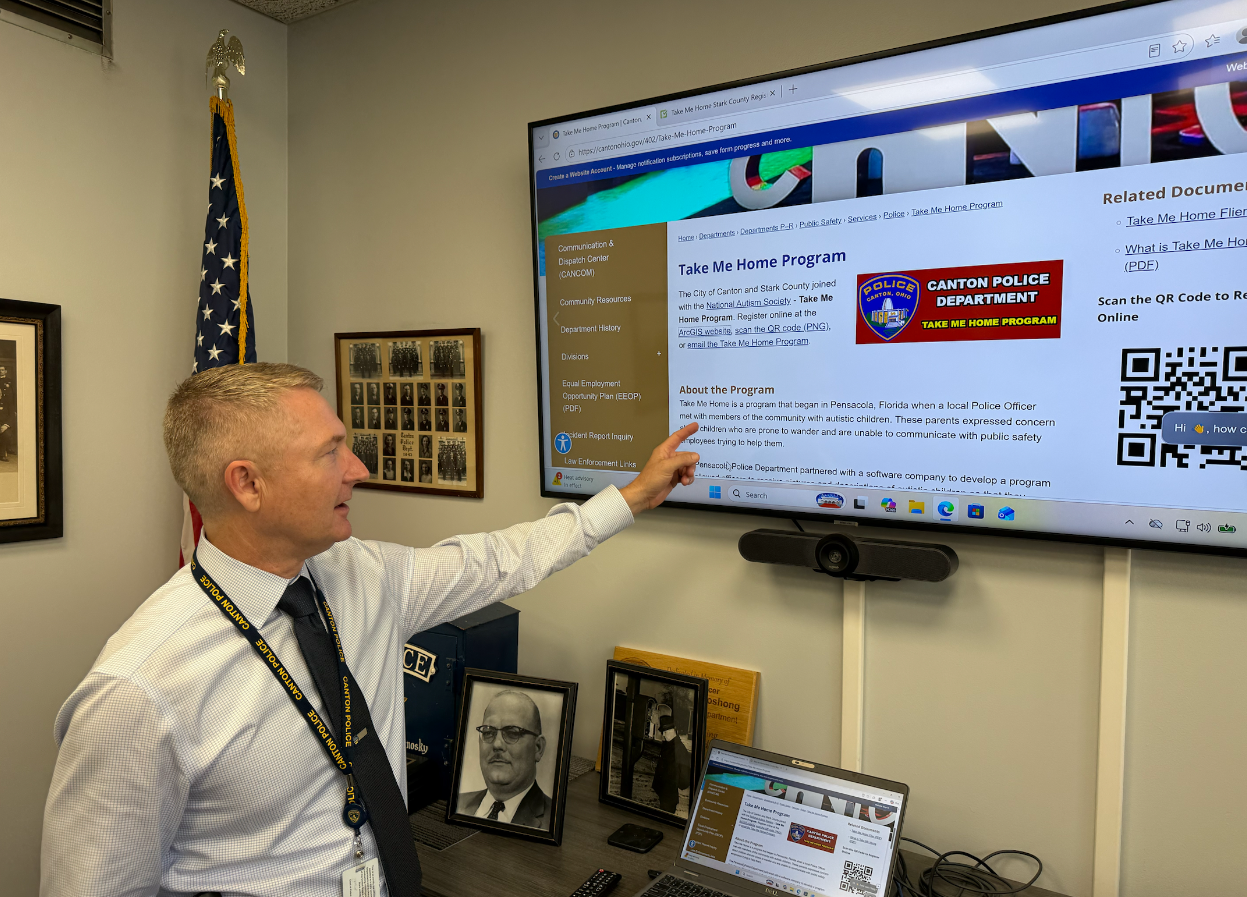
For families caring for a child with autism or an elderly loved one with dementia, the possibility of that person wandering away can be a constant source of worry.
What happens if they become lost? What if they cannot communicate their name or address? How will police know how to approach them safely?
A program developed in Canton is helping answer those questions by giving law enforcement officers access to critical information before an emergency ever happens.
Known as Take Me Home, the free program allows families throughout Stark County to voluntarily register loved ones in a computerized database containing photographs, physical descriptions, communication abilities and other information that could help officers locate and identify them if they go missing.
Canton Police Chief John Gabbard said the local initiative, launched in 2018, has since expanded beyond the city into a countywide effort involving multiple law enforcement agencies.
At its heart, he said, the program is about providing families with peace of mind while giving officers the tools they need to bring someone home safely.
A program born from parents’ concerns
The Take Me Home program originated in Pensacola, Florida, after a local police officer met with parents of children with autism who expressed concerns about their children wandering away.
The parents worried that their children might be unable to communicate with police officers or other emergency personnel trying to help them.
In response, the Pensacola Police Department partnered with a software company to develop a system that provided officers with photographs and descriptions of registered children, helping them reconnect those children with their families.
According to the city of Canton’s website , local officials learned about the program in 2017 and began developing their own version with the Stark County Auditor’s Geographic Information Systems Department.
Gabbard said the effort gained momentum when a Canton city employee approached him in 2018 about a program that could help protect her child, who has autism.
He began researching similar initiatives and discovered that some communities, including Summit County, were using paper records and physical photographs to identify missing individuals.
He believed Canton could take the concept further.
“I said, you know, I know we could do it better than this,” Gabbard recalled.
At the time, the Canton Police Department had already been working with Stark County GIS on a separate program that mapped residential security cameras to assist criminal investigations.
Gabbard saw an opportunity to apply that same technology to Take Me Home.
“So with that same concept, I said, look, we could build this database on a map, and once we have it and everything’s entered electronically, people don’t have to leave their home to set it up, and officers could get this on their mobile data terminals while they’re on the field,” he said.
Stark GIS developed a unique web-based platform, allowing officers to access registered individuals’ information directly from their patrol vehicles rather than relying on paper files kept at police headquarters.
“They built this from the ground up,” Gabbard said.
How Take Me Home works
Imagine an officer responding to a report of a young child wandering alone in a Canton neighborhood.
The child cannot communicate their name, address or parents’ contact information.
Rather than beginning the identification process without any information, the officer can access Take Me Home through a mobile data terminal or another web-enabled device and search the database for individuals matching the child’s description.
The system allows officers to narrow results using physical characteristics, including height, weight, scars, tattoos and other identifying features.
Photographs can then help officers determine whether the person they have encountered is registered in the system.
Gabbard demonstrated how officers can use the map to search for individuals in a particular area and filter records based on available information.
The database is not limited to children with autism. It can also assist in locating older adults with dementia and other individuals who may have difficulty communicating or finding their way home.
Gabbard said the program has already been used by officers in the field, although encounters involving missing, nonverbal individuals are relatively uncommon.
“We’ve used it. We’ve used it in the field. The officers do pull it up,” he said.
Traditional investigative methods, including knocking on doors and sending emergency notifications, remain important. However, Gabbard said the database can significantly reduce the time needed to identify someone who is registered.
“But this really shortens the path to that if they’re entered,” he said.
More than a photograph and an address
One of the program’s most important features is the ability for families to provide information that goes beyond a person’s physical appearance.
Registration records can include communication abilities, medical conditions, behavioral characteristics and other details that could influence how officers respond.
For example, a family can indicate whether their loved one is nonverbal, has diabetes or may become frightened when approached by someone wearing a police uniform.
Those details can help officers adjust their approach to avoid escalating an already stressful situation.
Gabbard described how a registration might indicate that an individual is likely to run if confronted by a uniformed officer.
“Those kind of things are important because it may change how we try to find them because if they run, it may be more dangerous because they’re afraid of officers,” he said.
In such a situation, police might consider sending a plainclothes officer instead.
Families can also enter additional information in an open-ended section of the registration form, allowing them to explain behaviors, communication needs or other circumstances that might not fit into a standard category.
Gabbard said having that information beforehand can help officers better understand the person they are trying to locate.
The database also eliminates the need for families to locate a recent photograph or provide basic identifying information in the middle of an emergency.
“We don’t have to wait for them to give us a picture. We don’t have to wait for other like basic description information,” Gabbard said.
From Canton to a countywide effort
Although the program began as a Canton initiative, Gabbard said it was designed to be accessible to other law enforcement agencies throughout Stark County.
Departments can provide their own registration links while sharing access to information entered into the system.
North Canton was among the early participants, and Gabbard also identified Uniontown as an agency involved in the program.
He said the database contains registrations extending well beyond Canton, including into surrounding communities.
“The idea that we have access to theirs, they have access to ours,” Gabbard said.
That cooperation can be particularly important when a missing person crosses municipal boundaries or is found outside their home community.
Gabbard said he has also presented the program at a meeting of area police chiefs to encourage additional participation.
The exact number of participating departments and individuals currently registered in the database was not immediately available. Gabbard said he planned to contact Stark GIS and department staff to obtain those figures.
According to the city’s website, the Canton Police Department administers the program, but it is available to every Stark County community at no charge. Information entered into the database is accessible only to law enforcement officers.
Giving families peace of mind
For Gabbard, the program’s value extends beyond the technology itself.
He said families caring for individuals who are prone to wandering often live with the fear that a loved one could leave home and encounter danger before anyone realizes they are missing.
That concern can be especially significant for families with children who may be drawn to bodies of water.
“I think what it does more than anything is it gives families a real sense of security, you know, especially when they have young people who wander, especially with autism, and they’re afraid of you know them being attracted to water, pools, lakes, things like that,” Gabbard said.
Although he could not identify a specific case in which the program directly led to a successful recovery, Gabbard confirmed that officers have used it and said its ability to provide information quickly is valuable.
He also emphasized that its effectiveness depends on community participation.
The more individuals registered, the greater the opportunity for officers to find a matching record when someone is missing.
“So the more we have in here, the better,” he said. “I think if we really really packed this full of registrations, then we’d have more success stories to talk about.”
How families can register
Families interested in Take Me Home can register through the Canton Police Department’s website.
The program is free and open to individuals of any age living in any Stark County community. Families can provide a photograph, physical description and information about their loved one’s communication needs.
The department also distributes informational cards containing QR codes that direct residents to the registration form.
Officers frequently promote the program at neighborhood gatherings and community events, where they can help families complete registrations, take photographs and enter information directly into the system.
Gabbard stressed that registration is not something families should complete once and forget.
As children grow, their height, weight, hairstyles and other physical characteristics can change significantly.
Families can update their loved ones’ records and photographs to ensure officers have the most accurate information available.
“Kids grow so fast,” Gabbard said. “You know, if a hair changes or things change so much, height and weight especially.”
The department continues to distribute information about Take Me Home at community events, but Gabbard acknowledged that it has been some time since the program received a major public promotion.
He hopes renewed attention will encourage more families to participate.
For parents and caregivers who have experienced the fear of a loved one wandering away, Gabbard said the program offers another layer of reassurance.
“I think it gives them a level of comfort. It makes them feel a little bit more secure,” he said. “And for us, obviously, any information we can get, anything that would shorten the process of trying to identify something is good for us.”
Families interested in registering a loved one can learn more and access the registration form through the Canton Police Department’s Take Me Home Program website .