
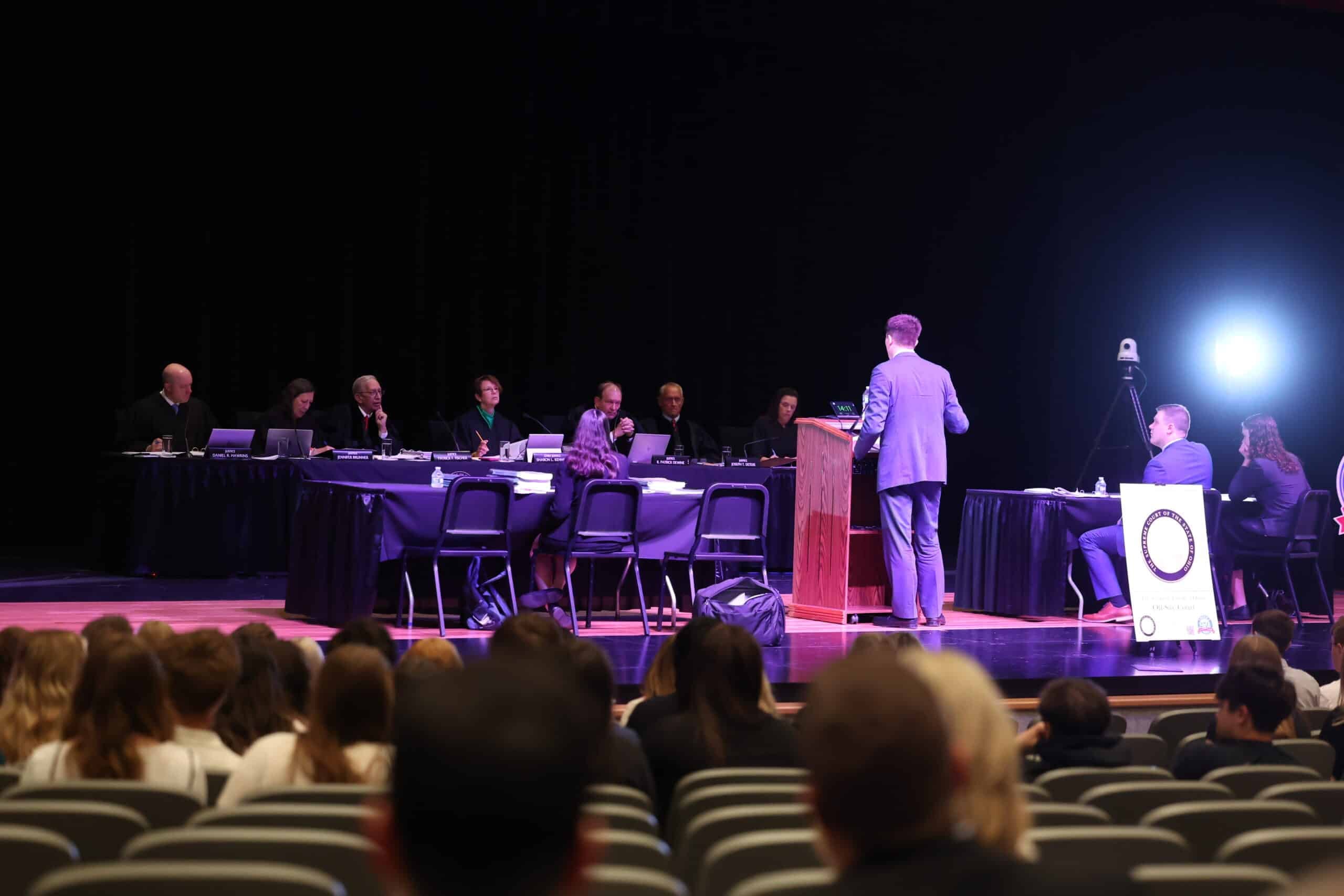
The Supreme Court of Ohio brought its courtroom to Carrollton High School on Wednesday, giving hundreds of local students a firsthand look at the state’s highest court in action.
Seven justices heard oral arguments in three cases as part of the court’s traveling civic education initiative, known as Off-Site Court. More than 900 students from four area high schools attended the special session, including sophomores, juniors and seniors from Carrollton High School, as well as juniors and seniors from Minerva High School, Malvern High School and Conotton Valley High School.
The event is designed to help students better understand the judicial system by allowing them to observe real cases and interact with legal professionals.
Key case: State v. McClain
One of the cases argued Wednesday involved a man convicted of rape following a DNA match made years after the assault was reported.
In State v. McClain, attorneys debated whether prosecutors sufficiently proved the defendant knew the victim was substantially impaired at the time of the assault.
The state argued that evidence — including the victim’s blackout and physical injuries — supported both the impairment and the defendant’s awareness of it, and that the lower court improperly weighed evidence rather than determining whether sufficient evidence existed to support the conviction.

The defense countered that the case relied too heavily on inference and lacked direct proof that the defendant knew of the impairment, arguing the evidence did not meet the standard of proof beyond a reasonable doubt and raising concerns about hearsay testimony.
Justices questioned both sides about the distinction between the sufficiency of evidence and the weight of that evidence — a central issue in the appeal. The court took the matter under advisement and will issue a written decision at a later date.
Traffic stop case: State v. Lebron-Novas
Another case centered on whether a traffic stop that led to a drug seizure was supported by reasonable suspicion.
In State v. Lebron-Novas, the court is considering whether a driver was unlawfully stopped for allegedly following a commercial truck too closely.
The trial court initially found that a state trooper had reasonable suspicion based on testimony and dash camera footage. However, an appellate court reversed that decision, citing inconsistencies between the officer’s account and the video evidence.
The state argued that both the trooper’s testimony and the dash-cam footage provide competent and credible evidence to justify the stop, emphasizing that the totality of the evidence supports reasonable suspicion.

The defense countered that the video contradicts key aspects of the trooper’s testimony and argued that appellate courts should defer to a trial court’s factual findings unless clearly disproven by the record.
Justices questioned how courts should evaluate video evidence compared to officer testimony and what standard of review should apply when appellate courts revisit trial court decisions. The outcome could influence how similar traffic stop cases are reviewed statewide.
The court took the case under advisement and will issue a decision at a later date.
Fourth Amendment case: State v. Barton
A third case focused on constitutional protections during traffic stops and the use of police K-9 units.
In State v. Barton, attorneys debated whether a drug-sniffing dog’s brief intrusion into a vehicle during a traffic stop constituted an illegal search under the Fourth Amendment.
The case stems from a traffic stop in which a driver refused consent for a search. During a canine sniff around the vehicle’s exterior, the dog jumped up and briefly extended its nose through the driver’s side window before alerting to the presence of drugs.
The driver argued that even a brief, three-second intrusion into the vehicle amounted to a warrantless search, violating constitutional protections and triggering the exclusionary rule.
The state countered that the dog’s actions were instinctive and minimal, arguing such a limited intrusion should not be considered a constitutional violation and warning of broader impacts on law enforcement practices.
Justices explored whether physical contact constitutes a search, how trespass principles apply, and whether minor or “micro” intrusions should trigger constitutional protections.
The court also discussed how similar cases have been handled in other states and the broader implications for policing across Ohio. As with the other cases, the justices took the matter under advisement and will issue a decision at a later date.
Civic education focus
The Off-Site Court program is the result of weeks of preparation by students, teachers, and local attorneys. Prior to the session, students reviewed case summaries provided by the court and participated in classroom discussions about legal concepts and Ohio’s judicial system.
After the arguments, students had the opportunity to meet with the attorneys who presented before the court to discuss the cases and careers in the legal field. A representative from the Ohio Access to Justice Foundation also spoke with students about opportunities in law.
Local judges Michael V. Repella and Sean R. H. Smith of the Carroll County Common Pleas Court served as co-hosts of the event.
Program history
The Off-Site Court program began in 1987 under Chief Justice Thomas J. Moyer as part of the bicentennial celebration of the U.S. Constitution.
This year’s visit coincides with the upcoming 250th anniversary of American independence on July 4, 2026. The Supreme Court is marking the milestone with a yearlong initiative titled “The Story of America,” aimed at promoting civic understanding and highlighting key moments in U.S. and Ohio history.
Carroll County’s hosting of the session represents a continued effort by the court to engage communities statewide and bring the judicial process directly to Ohio students.