
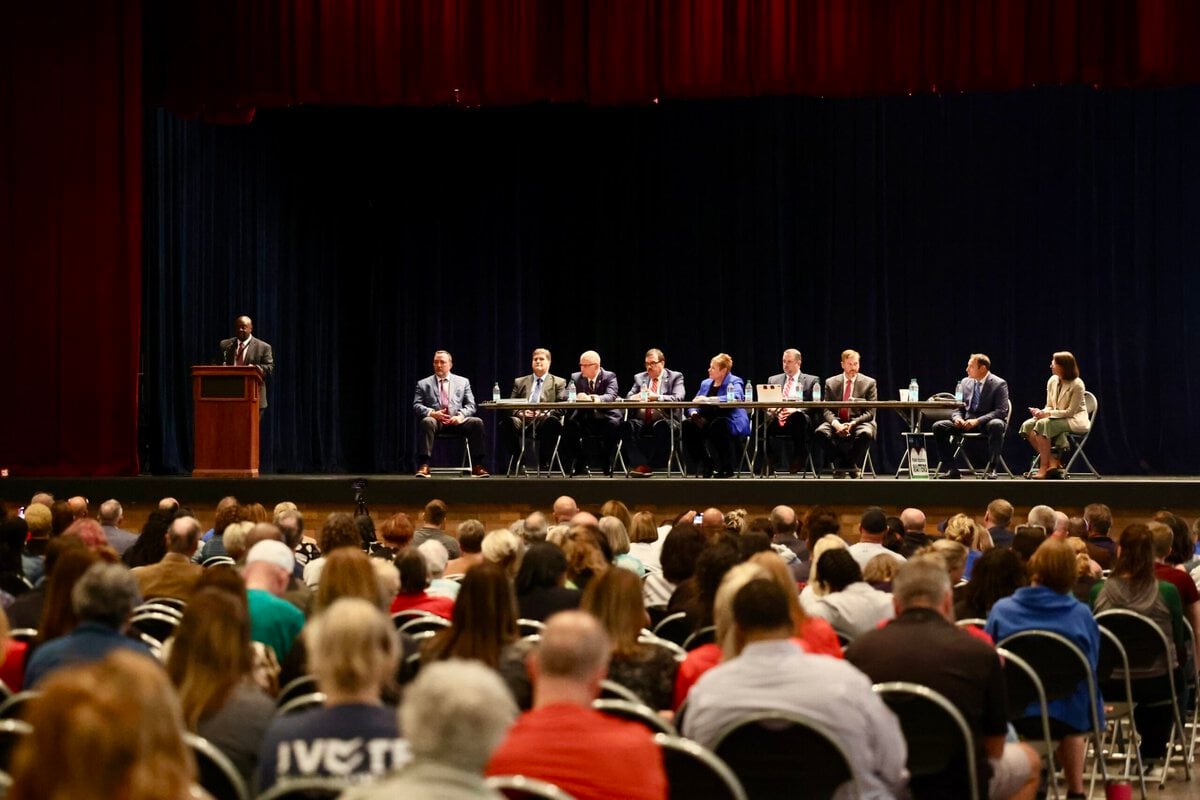
Stark County educators and community members filled the Canton Memorial Civic Center on June 10 to rally in support of public education, raising concerns about proposed state budget measures that they fear could devastate local school districts.
Approximately 1,200 attendees, including teachers, administrators, and concerned residents, joined the event, organized by Canton Mayor William V. Sherer II. The rally featured local education leaders who criticized budget proposals from Columbus, warning they could have dire consequences for school funding, programming, and student services.
Lake Local Superintendent Kevin Tobin, who is retiring after 37 years in education, delivered a sobering message. “I’ve never seen us under such siege,” Tobin said. “I’ve used the term that this is criminal of our legislation to do what they are doing. It is absolutely criminal and incomprehensible that we are not caring for our students and our children in the manner that’s effective and needed in the state of Ohio.”
Mayor William Sherer called the proposed cuts an attack on public education.
“Public education is under attack from Columbus, and the effects could be potentially fatal for some Stark County districts,” Sherer told the crowd. “When you wage war on public education, you are attacking the mortar that holds the community together.”
Sherer stressed that the issue isn’t political but fundamental to the well-being of Ohio’s youth. He emphasized that the issue transcends politics and is ultimately about protecting the future of children.
Plain Local Schools Superintendent Brent May echoed Sherer’s concerns, calling the proposals a direct threat to school operations across the county. “We are one county united in one goal — bring awareness to what is happening in Columbus,” May said. They believe the proposed changes could rapidly undermine and break apart public school systems throughout Stark County.
At the heart of the concern are the budget proposals moving through the Statehouse. Educators warned that plans targeting rainy-day funds, underused facilities, and specific programming could significantly undermine public education.
May outlined the potential financial losses for his district under various versions of the state budget. Under the governor’s plan, Plain Local would lose $2.7 million in fiscal year 2026, followed by another $1.7 million the next year. The Ohio Senate’s proposal projects a $2.2 million annual loss. The Ohio House plan would flat-fund the district for two years, then slash more than $8 million over the following two years.
Plain Local has already cut $3 million from its budget in anticipation of the funding shortfall. May said possible future cuts could affect arts, career and technical education, College Credit Plus courses, mental health services, transportation, STEM programs, and extracurriculars.
Local leaders emphasized that community action is essential to pushing back against the proposals. The rally was a call to unity — urging educators, parents, and voters to speak out in defense of Ohio’s public schools before irreversible damage is done.
Educators at the rally also raised serious concerns about a proposal that could require public schools to close underused buildings and sell them at discounted prices to charter schools.
The provision would target any school building operating below 60% capacity, forcing its closure and triggering a mandated sale—often below market value—to charter institutions. Current state law already gives charter schools priority when districts put buildings up for sale, but this new measure would remove local discretion and impose further mandates.
“We’re not looking to maintain or heat buildings we don’t use,” said Canton City Schools Superintendent Jeff Talbert. “But forcing sales through bad policy creates consequences that impact students and communities.” Talbert emphasized that many of the facilities in question serve specialized functions—such as behavior intervention programs or crisis management spaces—that cannot be easily replicated elsewhere.
For Canton City Schools, that could mean shuttering sites like the early college and career academy located on the former Timken High School campus.
Sherer said he organized the public forum after conversations with Talbert, who shared the far-reaching implications of the proposal. “These are not partisan issues,” Sherer said at the event. “This is about the future of our kids, our schools, and our neighborhoods.”
While critics argue the proposed measure undermines local control, Governor Mike DeWine has defended it, suggesting some districts are deliberately holding onto empty buildings to avoid competition from charters. The governor contends the policy aims to promote fair access.
The state Senate is expected to vote on its version of the budget this week. Lawmakers from both chambers will need to reconcile their differing proposals before the final budget is presented to Governor DeWine for signature by the end of the month.